Large language models can produce impressive responses, but anyone who has used them regularly will have seen the effects of data drift, model drift, and changes caused by new input data. You ask the same question twice and get two different structures, two different tones, or extra details that were never part of your brief. This is a familiar pattern in large language models (LLMs) and is one reason users report inconsistent behaviour.
These changes come from shifts in input distributions, variations in user behaviour, and the natural sensitivity of generative AI models to phrasing. In traditional machine-learning systems, concept drift occurs when the relationship between training data and production data changes, altering model predictions. Something similar happens in LLMs, though it shows up in different ways, such as tone shifts, structural inconsistencies, and drifting answers that don’t match historical data patterns or user expectations.
Our recent research explores whether a structured, inference-time operator can improve LLM behavioural stability without modifying weights or creating automated re-training pipelines. The findings are encouraging.
Understanding data drift and input data instability in LLMs
In machine-learning, data drift describes changes between reference data used during model development and the incoming data the model sees later. When the statistical properties of input data move away from the same distribution as the original training datasets, performance suffers. This is why data scientists use tools like population stability index, statistical tests, and probability distributions to detect significant deviations.
LLMs experience their own version of this. Instead of numeric features drifting, we see:
• tone shifts
• structural variance
• different linguistic variations
• inconsistent constraint adherence
This type of drift in LLMs affects model responses, model accuracy, and perceived LLM performance. It leaves users wondering why the model changes direction mid-answer or expands a prompt unexpectedly.
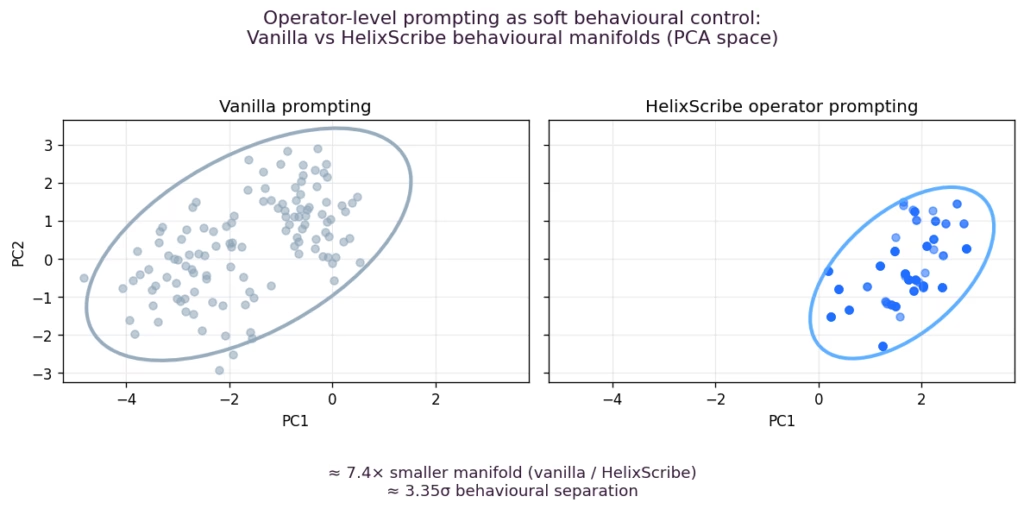
The preprint analyses these issues through behavioural metrics, showing clear separation between vanilla prompting and operator prompting using PCA and manifold-based methods.
Concept drift: when the model’s internal behaviour shifts
In classical systems, concept drift means that the underlying relationship between inputs and outputs changes. In LLMs, this can show up as:
• altered reasoning structure
• new output patterns triggered by subtle changes in user inputs
• unexpected additions or omissions
• loss of consistency across similar tasks
LLMs are sensitive to prior probability shift, covariate drift, and changes in the way users present information. This makes tracking drift essential for any workflow trying to maintain accurate responses or predictable structure.
The operator described in the research stabilises these internal transitions, creating a narrower behavioural regime even when data changes or users introduce new input data.
Data drift detection and behavioural signals in LLMs
While traditional data drift detection relies on monitoring feature distributions, drift detection methods for LLMs must account for structural and linguistic shifts. The research paper examines drift through:
• reading-ease metrics
• word-count variance
• constraint adherence
• drift vectors showing movement between behavioural states
• manifold volume
• maximum distance between clusters
This enables a form of effective drift detection for language-based outputs, even though LLMs don’t rely on fixed numerical features.
The operator produced a 7.4× reduction in manifold size, indicating far lower drift across repeated generations. It also showed stability when faced with adversarial or noisy instructions, highlighting the potential for more consistent behaviour without altering the underlying pre-trained models.
Drift detection methods for real-world use
Modern machine-learning models often incorporate continuous monitoring, making continuous monitoring easier through automated dashboards, or using patterns from historical data. LLMs complicate this, because outputs depend on context that shifts continuously with each prompt.
However, the research shows a path forward. Structural metrics can act as a proxy for behavioural stability, embedding drift can be used when appropriate, recent data can be compared to original training data behaviours, and drift can be monitored through prompt-specific variance patterns. Where possible, workflows can also incorporate tracking explicit feedback.
These methods align well with existing drift detection strategies used in data engineering, software development, and traditional machine learning models.
Drift in LLMs: a dominant source of inconsistency
The paper highlights that much of the day-to-day inconsistency users encounter comes from:
• internal reasoning shifts
• structural drift
• stylistic drift
• prompt misinterpretation
• distribution shifts in how the model handles language
This is not the same as large-scale training data drift. It is a behavioural effect at inference time. The operator helps by constraining transitions in the sequence from intent → category → plan → method → pattern → response, reducing opportunities for drift.
This can make real-world content workflows more reliable, with fewer retries and less manual editing.
Continuous monitoring for long-term LLM performance
For long-term reliability, both classical and language-based systems benefit from several practices. These include continuous learning signals (human-provided rather than weight-updating), monitor drift dashboards, comparison against reference data, and watching for distribution shifts. It also helps to track performance metrics and model performance over time, apply data augmentation strategies for retrieval pipelines, and evaluate whether retrieval augmented generation can support stability.
Although the operator does not fine-tune the model, it improves stability by design, reducing the need for repeated prompt adjustments or human corrections.
Data engineering principles applied to LLM stability
Techniques often used in classical data engineering and machine learning model monitoring apply here too. These include checking for production data divergence, evaluating text-based data points for pattern changes, using lightweight statistical methods to spot emerging shifts, applying guardrails and human oversight, and mitigating drift before it impacts users.
This mirrors established practice in maintaining structured pipelines, adapted for language-based outputs.
Data augmentation and continuous learning signals
While the operator itself does not update weights, it works well alongside broader workflows that support stability. Teams often use data augmentation to improve grounding, add continuous learning signals through user feedback, or rely on online learning systems that adapt to incoming data. Structured prompting can reduce model drift at inference, and careful framing helps mitigate concept-level instability. Together, these approaches maintain clarity and predictability without creating an over-engineered pipeline.
Explore operator-level prompting
If you want to explore the methods, metrics, and behavioural evidence, the full preprint includes PCA analysis, manifold compression, drift vectors, adversarial tests, and comparisons between prompting regimes.
Read the research: https://zenodo.org/records/17688010 or send us an email [email protected] to find out more.